When Did We Stop Dreaming About Better Futures?
For much of the twentieth century, visions of tomorrow were closely tied to ideas of progress, exploration, and possibility. Today, however, public conversations about the future are often dominated by climate breakdown, geopolitical instability, technological disruption, and social fragmentation. The future has not disappeared from our imagination, but it has increasingly become a source of anxiety rather than aspiration.
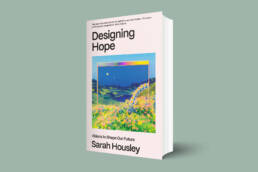
In Designing Hope: Visions to Shape Our Future, design futurist Sarah Housley challenges this trend. Rather than offering predictions or utopian blueprints, she explores how futures thinking can help us develop richer and more constructive narratives about the decades ahead. The book argues that if we are to address the complex challenges of our time, we must first expand our capacity to imagine alternatives.
Four Futures, Not One.
A key strength of Designing Hope is its refusal to present a single vision of what lies ahead. Instead, Housley explores four emerging futures – More-than-Human, Degrowth, Solarpunk, and the Metaverse—each representing a different way of organizing society, technology, and our relationship with the planet. Drawing on examples from design, science, culture, and innovation, she examines how these ideas are already taking shape in the present and what they might mean if developed further.
Importantly, the book is less concerned with predicting the future than with making futures thinkable. As Housley argues, the future is not a destination waiting to be discovered but a space that can be shaped through imagination, participation, and collective action. The book also includes practical exercises that encourage readers to engage in futures thinking themselves, transforming the reading experience into an invitation to actively explore possibilities.
Hope as a Design Practice.
One of the book’s most compelling ideas is that hope should not be understood as passive optimism. In an interview with Wallpaper, Housley explains that “hope always has to come with action and with critical thinking.” Rather than denying the realities of ecological and social crises, she suggests that hope can function as a tool for engaging with them creatively and constructively.
The book emerged from Housley’s concern that contemporary culture has become increasingly constrained by dystopian narratives. By introducing alternative futures grounded in existing projects, movements, and emerging practices, she seeks to widen the conversation and reintroduce a sense of possibility into public discourse. In this sense, Designing Hope is not a manifesto for a single future but an invitation to explore multiple pathways forward.
Voices from the Critics:
“We’ve stopped believing in or imagining a future. That’s deadly. Housley’s visionary yet bracingly practical book is an antidote to despair and a manual for our very survival.” – Charles Foster, author of Cry of the Wild
“We need some adventure in the fight for a workable future—some stuff to be aiming at and dreaming about. This book will fire up your imagination!” – Bill McKibben, environmental author and co-founder of 350.org
“A rare and spirited optimism, made all the more powerful by its grounding in fact.” – Emily Buchanan, author of Send Flowers
Why this matters for Anthrotopia?
Designing Hope contributes meaningfully to this conversation by reminding us that imagination is not a luxury but a prerequisite for transformation. Whether exploring multispecies design, wellbeing economies, solarpunk visions, or alternative technological futures, Housley’s work encourages a broader question: what kinds of futures are we collectively designing, often without realizing it? By expanding the range of futures we can imagine, the book also expands the range of futures we might choose to create. Designing Hope is a reminder that the future remains open – and that cultivating hopeful, plural, and participatory visions of tomorrow may be one of the most important design challenges of our time.
Images: © Indigo Press