From Separation to Participation.
Trees exchange nutrients through underground fungal networks. Insects pollinate flowers. Rivers shape landscapes. Microorganisms transform soil into living ecosystems. For millions of years, life has flourished through relationships, exchanges, and interdependence rather than isolation. Yet humans came to imagine themselves as separate from it.
1. Confidence
The modern world was built upon a powerful assumption: humans are fundamentally different from everything else. From this emerged the idea that humans stood apart from – and ultimately above – the web of life. We alone seemed to possess reason. We alone seemed to create culture. We alone seemed to shape history. Nature seemed to exist for human purposes. Progress became the story of humanity’s growing ability to understand, control, and transform the world around it. This belief shaped modern science, economics, politics, education, design, and many other domains. It helped unlock extraordinary achievements while giving rise to a worldview in which humanity occupied a privileged position in the order of things.
2. Destabilization
Today, that certainty is beginning to fracture. Climate change reminds us that human flourishing cannot be separated from planetary health. The atmosphere is not merely a backdrop to human activity but a living condition of our existence. The stability of societies depends upon forests, oceans, soils, and climate systems functioning well. Artificial intelligence introduces another challenge. Systems can now generate text, create images, compose music, write software, and solve increasingly complex problems. Capacities once treated as uniquely human no longer appear exclusively human. Biotechnology blurs boundaries that once seemed obvious. Genetic engineering, synthetic biology, and bio-digital systems challenge distinctions between the natural and the artificial, the given and the designed. The story of the independent human actor begins to unravel.
3. Uncertainty
As old assumptions weaken, a deeper question emerges. If humans are not separate from the systems that sustain them, then who are we? Biology offers an intriguing clue. Human beings are not self-contained entities. Every body hosts vast communities of microorganisms that influence digestion, immunity, metabolism, and many other aspects of our well-being. We are less isolated individuals than living ecosystems. Ecology points in the same direction. Life is fundamentally relational, unfolding within complex networks that connect all living beings. Technology adds another layer. Increasingly, our thinking, communication, memory, and decision-making are mediated by digital systems. The boundaries between human and technological agency are becoming harder to define. The more we learn, the more difficult it becomes to sustain the image of the autonomous individual standing apart from the world. We find ourselves in unfamiliar territory. The old picture no longer feels adequate. The new picture has not yet fully emerged.
4. Recognition
Across philosophy, ecology, and science, a growing number of thinkers have sought to articulate this emerging picture. One of the most influential responses has become known as Posthumanism. Despite its futuristic sound, Posthumanism is less concerned with what comes after humanity than with rethinking what it means to be human. It begins with a question: what happens when the assumptions that defined the modern human no longer seem adequate? In that sense, we may already be living in what some thinkers describe as the posthuman condition – not an era after humanity, but after the certainty that humans stand apart from everything else. From this starting point, different responses emerge. Some thinkers, particularly within Transhumanism, view technological development as an opportunity to overcome biological limitations and expand human capabilities. In this vision, the future lies in becoming more than human through artificial intelligence, genetic engineering, and technological enhancement. Others pursue a different path. Critical Posthumanism is less interested in transcending the human than in rethinking it. Thinkers such as Donna Haraway, Rosi Braidotti, Cary Wolfe, and Bruno Latour have explored how distinctions between human and animal, organism and machine, nature and culture have always been more porous than we imagined. Rather than asking how humans might surpass their condition, they ask whether the autonomous human of modern thought was ever an accurate description in the first place. What unites these otherwise different perspectives is not a rejection of humanity, but a rejection of human isolation. The human is no longer understood as standing apart from or above the world but as part of it.
5. Possibility
Many assume that questioning the idea of human separation means diminishing human value. Perhaps it means something different. To see ourselves as participants in larger ecological, technological, and social systems is not to become less important, but to understand our place in the world differently. From this perspective, the question is not whether humans matter, but what kind of humans we might become. What kinds of cities would we design if we saw ourselves as members of ecosystems rather than masters of them? What kinds of technologies would we create if intelligence were understood as distributed rather than exclusively human? What kinds of economies might emerge if flourishing were measured not only by human prosperity but by the health of the systems that sustain it? What forms of culture, governance, and coexistence might become possible if we embraced our interdependence? Rethinking humanity opens the possibility of a different relationship with the living world. Not mastery. Not domination. Not withdrawal. But participation.
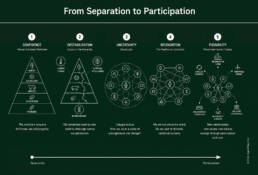
From Separation to Participation. A conceptual model illustrating the transition from a human-centered worldview toward a relational understanding of humanity in the context of posthuman thought. @ 2026, Ingrid Rügemer
Why this matters to Anthrotopia?
This essay articulates one of Anthrotopia’s foundational questions: How might humanity understand its place in a world it neither stands above nor exists outside? The movement from separation to participation offers a conceptual orientation for the platform as a whole. It invites us to explore how art, design, science, and beyond might contribute to more relational ways of thinking and living – to forms of coexistence grounded not in mastery, but in interdependence, responsibility, and participation.
Selected References
Modern Humanism and the Autonomous Human
Bacon, F. (2000). The new organon (L. Jardine & M. Silverthorne, Trans.). Cambridge University Press. (Original work published 1620)
Descartes, R. (2006). Discourse on the method (I. Maclean, Trans.). Oxford University Press. (Original work published 1637)
Kant, I. (2009). An answer to the question: What is enlightenment? Penguin Books. (Original work published 1784)
Rethinking the Human
Darwin, C. (2009). On the origin of species. Penguin Classics. (Original work published 1859)
Freud, S. (1964). Introductory lectures on psycho-analysis. W. W. Norton. (Original work published 1917)
Lovelock, J. E. (1979). Gaia: A new look at life on Earth. Oxford University Press.
Margulis, L. (1998). Symbiotic planet: A new look at evolution. Basic Books.
Interdependence, Ecology, and the Posthuman Condition
Latour, B. (1993). We have never been modern. Harvard University Press.
Latour, B. (2018). Down to Earth: Politics in the New Climatic Regime. Polity Press.
Morton, T. (2013). Hyperobjects: Philosophy and ecology after the end of the world. University of Minnesota Press.
Tsing, A. L. (2015). The mushroom at the end of the world: On the possibility of life in capitalist ruins. Princeton University Press.
Posthumanism
Braidotti, R. (2013). The posthuman. Polity Press.
Haraway, D. J. (2016). Staying with the trouble: Making kin in the Chthulucene. Duke University Press.
Hayles, N. K. (1999). How we became posthuman: Virtual bodies in cybernetics, literature, and informatics. University of Chicago Press.
Wolfe, C. (2010). What is posthumanism? University of Minnesota Press.
Participation and Relational Futures
Leopold, A. (1949). A Sand County Almanac. Oxford University Press.
Albrecht, G. (2019). Earth emotions: New words for a new world. Cornell University Press.
Escobar, A. (2018). Designs for the pluriverse: Radical interdependence, autonomy, and the making of worlds. Duke University Press.
Raworth, K. (2017). Doughnut economics: Seven ways to think like a 21st-century economist. Chelsea Green Publishing.
Header image: © anthrotopia.com
Conceptual model: © 2026, Ingrid Rügemer